
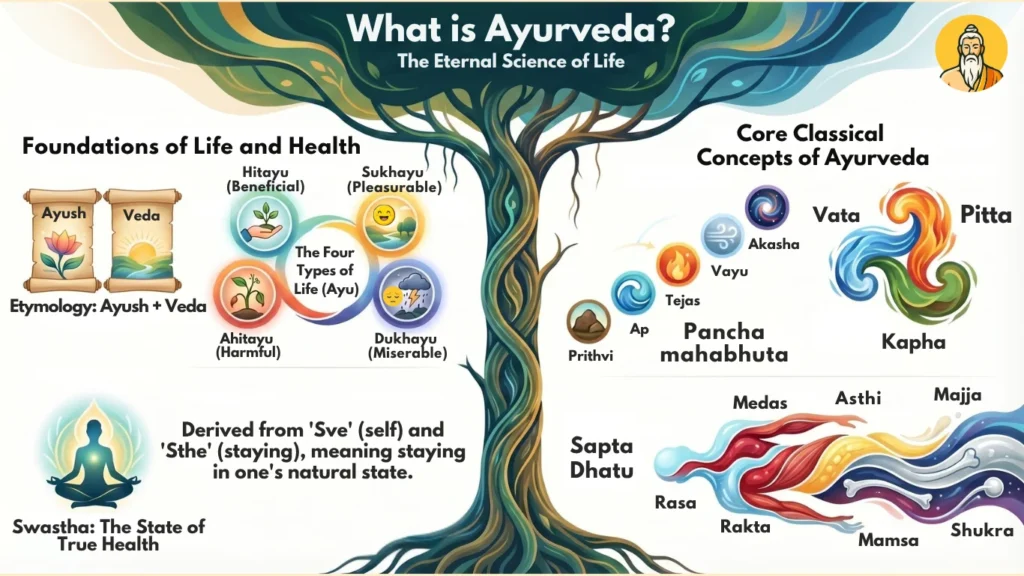
Ayurveda is the oldest living philosophical-based medical science, deeply rooted in the ancient traditions of India. It is not merely a system of therapeutics, but a holistic science that advocates for the promotion of positive health, the prevention of diseases, and the attainment of a long, happy, and prosperous life.
To truly understand Ayurveda, one must delve into its classical roots, etymology, and the fundamental principles established by ancient sages thousands of years ago.
- Meaning of Ayurveda: Understanding Ayu and Veda
- The Four States of Life and the Goal of Ayurveda
- The Dual Objectives of Ayurveda
- The Classical Definition of Health (Swastha)
- Core Classical Concepts of Ayurveda
- Ashtanga Ayurveda: The Eight Branches
- The Divine Origin and Eternal Nature of Ayurveda
- FAQs
- What is Ayurveda in simple words?
- What is the meaning of Ayurveda?
- What does Ayurveda include?
- Why is Ayurveda called the science of life?
- Is Ayurveda only about herbal medicine?
- What is the main aim of Ayurveda?
- What are the basic principles of Ayurveda?
- What is health according to Ayurveda?
- How does Ayurveda explain disease?
- Is Ayurveda still relevant today?
- Dr Himanshu AryaAyurvedic Doctor
Meaning of Ayurveda: Understanding Ayu and Veda
The term Ayurveda is composed of two Sanskrit words: Ayu (life) and Veda (knowledge or science). Therefore, Ayurveda translates to the “Science of Life”. In classical Ayurvedic texts, Ayu is not defined simply as the physical lifespan. Instead, it is the continuous amalgamation of four essential components:
- Sharira: The physical body.
- Indriya: The sensory and motor organs.
- Sattva: The mind.
- Atma: The conscious principle.
To further explain the actual meaning of life, the ancient seers gave Ayu several profound synonyms:
- Dhari: That which holds life together, preserves the body from wear and tear, and prevents decay.
- Jivitam: The active living process or the vital life force (Prana) that sustains existence.
- Nityagam: The continuous, dynamic, and ever-moving state of life.
- Anubandha: The unbroken connection between the past, present, and future lives.
The Four States of Life and the Goal of Ayurveda
Ayurveda evaluates human life across four different spectrums:
- Hitayu (Beneficial Life): A life of righteousness, health, and benevolent activities.
- Ahitayu (Harmful Life): A life filled with malevolent activities and ignorance.
- Sukhayu (Pleasurable Life): A life endowed with youth, strength, good health, and peace of mind.
- Dukhayu (Miserable Life): A life burdened by disease, poverty, and suffering.
Ayurveda is the science that dictates what is good or bad for life, detailing these four states and explaining the measurement of the life span
The Dual Objectives of Ayurveda
The foundational aims of Ayurveda are beautifully summarized in the classical aphorism: “Swasthasya swasthya rakshanam aturasya vikara prashamanam cha”. This translates to two primary objectives:
- Preventive: To preserve and maintain the health of a healthy individual.
- Curative: To cure the disease of an ailing patient
The Classical Definition of Health (Swastha)
According to the great ancient surgeon Sushruta, health is not merely the absence of disease. A healthy person (Swastha) is defined by the following verse: “Samadoshah samagnischa samadhatu malakriyah | Prasannatmendriyamanah swastha ityabhidhiyate ||”.
This means health is an absolute equilibrium of:
- Doshas: Balanced bio-energies.
- Agni: Balanced digestive and metabolic fire.
- Dhatus and Malas: Proper formation of body tissues and normal excretion of waste products.
- Coupled with a blissful and pleasant state of the soul (Atma), senses (Indriya), and mind (Manas).
Core Classical Concepts of Ayurveda
Loka-Purusha Samya (The Microcosm-Macrocosm Continuum)
A fundamental doctrine of Ayurveda is the theory of macrocosm and microcosm (Purushasya lokatulyatvam). The term Purusha refers to the human body, and Loka refers to nature or the universe. This principle dictates that whatever elements are present in the vast universe are equally present in the human body, and vice versa
Panchamahabhuta
Ayurveda has adopted the Panchamahabhuta theory from the Sankhya system of philosophy, which states that every substance in the universe, including the human body, is composed of five primordial elements.
- Akasha: Possesses the attribute of sound (Shabda) and represents non-obstruction and the body’s empty spaces (like channels and pores).
- Vayu: Possesses the attributes of sound and touch (Sparsha). It is responsible for all micro and macro movements, respiration, and tactile sensations.
- Agni / Tejas: Possesses the attributes of sound, touch, and form/vision (Rupa). It is responsible for heat, digestion, metabolism, and intelligence.
- Jala / Ap: Possesses sound, touch, form, and taste (Rasa). It governs moisture, cohesion, bodily fluids (plasma, blood), and cooling mechanisms.
- Prithvi: Possesses all five attributes, including smell (Gandha). It provides stability, structure, and mass to the body (like bones, nails, and teeth).
The Tridosha (The Three Vitiators)
Modern interpretations frequently mislabel the Doshas as “bio-energies.” However, authentic classical Ayurveda defines the Doshas as material substances present in the body always, possessing their own definite quantity (pramana), quality (guna), and functions (karma).
The literal meaning of the word Dosha is “that which causes decay, destruction, or vitiates” (“dushyanti iti doshah”). When they are in their normal state (Prakrta), they attend to different functions and support the body. However, they have an inherent tendency to become abnormal (Vikrta)—either increasing or decreasing—at which point they vitiate the tissues (Dhatus) they dwell in and cause disease.
There are three bodily (Shariraka) Doshas: Vata, Pitta, and Kapha.
A. Vata (The Principle of Movement)
- Etymology: The term Vata is derived from the root “Va gatigandhanayo”, which means to move, to enthuse, and to initiate effort.
- Properties (Gunas): Vata is characterized by dryness (ruksha), lightness (laghu), coldness (sita), roughness (khara), subtleness (suksma), and continuous movement (cala).
- Classical Functions: In its normal state, Vata is the “purveyor” of the body. It protects the body by bestowing enthusiasm, governing expiration and inspiration, controlling all physical activities, initiating natural urges (like urine and faeces), and maintaining the acuity of the sense organs
B. Pitta (The Principle of Digestion and Heat)
- Etymology: The word Pitta is derived from the root “Tap santape”, indicating the creation of heat, oxidation, or transformation. It represents the fire-like agency (Agni) inside the body.
- Properties (Gunas): Pitta is slightly unctuous (sasneha), penetrating (tiksna), hot (ushna), light (laghu), bad-smelling (visra), free-flowing (sara), and liquid (drava).
- Classical Functions: Pitta sustains the body through digestion (pakti), maintenance of body temperature (ushma), visual perception (darshana), hunger, thirst, complexion, intelligence, and courage.
C. Kapha / Sleshman (The Principle of Cohesion)
- Etymology: Kapha is often referred to as Sleshman, derived from a root meaning “to embrace” or “to hold together,” representing union, stability, and compactness.
- Properties (Gunas): Kapha is unctuous (snigdha), cold (sita), heavy (guru), slow/dull (manda), smooth (slaksna), slimy (mrtsna), and stable (sthira).
- Classical Functions: Kapha provides the body with stability, lubrication for the joints, structural compactness, forbearance, physical strength, and immunity/vitality
Sapta Dhatu (The Seven Basic Tissues)
To build and maintain the physical structure, the body utilizes seven fundamental tissues known as Dhatus.
- Etymology: The term Dhatu is derived from the Sanskrit verb root “dhru-dharana-poshanayo”, which translates to “that which supports (dharana) and nourishes (poshana) the body”.
These tissues also serve as Dushyas—meaning they are the materials that get vitiated when the Doshas become abnormal. The Sapta Dhatus and their specific classical functions are:
- Rasa (Plasma/Nutrient fluid): Provides a sense of satisfaction (prinana) and base nourishment to the blood.
- Rakta (Blood): Sustains life activities (jivana) and nourishes the muscle tissue.
- Mamsa (Muscle): Covers the skeletal frame (lepa) and nourishes the fat.
- Medas (Adipose/Fat): Provides lubrication (sneha) to the body and nourishes the bones.
- Asthi (Bone): Supports the body’s structural framework (dharana).
- Majja (Bone Marrow): Fills the bone cavities (purana), provides strength, and nourishes the reproductive tissue.
- Shukra (Reproductive Tissue): Responsible for the production of the embryo (garbhotpada), conferring ultimate strength and vitality
Mala (The Waste Products)
Ayurveda places immense importance on the proper excretion of physiological wastes. The body produces three primary Malas that must be eliminated to maintain health:
- Purisha (Faeces): Its function in the body is to provide sustenance and strength to the colon, supporting the downward movement of Vata.
- Mutra (Urine): Its function is the elimination of excess moisture (kleda) from the ingested food and body.
- Sweda (Sweat): Its function is to maintain the unctuousness (greasiness) of the skin and support the body’s hair follicles
5. Agni (The Internal Fire)
Agni literally translates to fire, but in Ayurveda, it refers to the “fire-like activity” present in the alimentary canal and tissues, responsible for the digestion of food and tissue metabolism (Paka).
The primary Agni is located in the stomach and intestines (Jatharagni or Koshtagni). Health heavily depends on its state:
- Samagni (Normal Digestion): When all three Doshas are in equilibrium, the digestive fire is perfect, digesting normal quantities of food without difficulty.
- Vishamagni (Erratic Digestion): Caused by aggravated Vata, making digestion irregular and accompanied by flatulence.
- Tikshnagni (Intense Digestion): Caused by aggravated Pitta, leading to hyperactive digestion, burning sensations, and severe thirst.
- Mandagni (Weak Digestion): Caused by aggravated Kapha, leading to slow, sluggish digestion, heaviness, and lethargy.
If the Agni is weak, food is not processed properly, resulting in a toxic, uncooked metabolic residue called Ama, which clogs the body’s channels (Srotas) and acts as the root cause of most systemic diseases.
Ashtanga Ayurveda: The Eight Branches
Far from being a simple system of herbal remedies, classical Ayurveda is a highly sophisticated medical system divided into eight specialized branches (Ashtanga Ayurveda):
- Kaya Cikitsa: Internal medicine.
- Bala Cikitsa (Kaumarabhritya): Paediatrics, dealing with the care of children and their diseases.
- Graha Cikitsa (Bhutavidya): Psychiatry and demonology, dealing with diseases caused by unseen entities like evil spirits or micro-organisms.
- Urdhvanga Cikitsa (Salakya Tantra): Treatment of diseases above the clavicle, including eyes, ears, nose, throat, and head (Ophthalmology & ENT).
- Salya Cikitsa: Surgery, dealing with the extraction of foreign bodies and the use of surgical instruments.
- Damstra Cikitsa (Agada Tantra): Toxicology, dealing with the treatment of poisons from snake bites, insects, etc..
- Jara Cikitsa (Rasayana): Geriatrics and rejuvenation therapy, aimed at delaying old age and increasing immunity.
- Vrisha Cikitsa (Vajikarana): Aphrodisiacs and virilification therapy, addressing fertility and sexual vigour.
The Divine Origin and Eternal Nature of Ayurveda
Historically, the Samhitas (classical texts) trace the descent of Ayurveda from divine origins. It is stated that Lord Brahma, the creator of the universe, recalled the science of life and taught it to Daksha Prajapati. Prajapati then passed it to the Ashvin twins (the celestial physicians), who taught it to Lord Indra. When diseases began plaguing humanity, great sages approached Indra, who transmitted this knowledge to mortal sages like Bharadwaja and Atreya Punarvasu to redeem mankind.
Despite this historical lineage, Ayurveda is universally considered Saswata (eternal) and Anadi (without a beginning). This is because it is intrinsically linked to the natural laws of the universe. The principles of nature, the properties of the elements, and the continuity of life have always existed, making the science of life an eternal truth
FAQs
What is Ayurveda in simple words?
Ayurveda is the science of life that explains how to maintain balance in the body, mind, senses, and consciousness. It focuses on preventing disease and also provides methods for treating disorders when imbalance occurs.
What is the meaning of Ayurveda?
The word Ayurveda is derived from two Sanskrit terms — Ayu (life) and Veda (knowledge). It means the knowledge or science of life, which explains the nature of life and how to maintain it in a balanced state.
What does Ayurveda include?
Ayurveda includes concepts such as Dosha (functional principles), Dhatu (tissues), Mala (waste products), Agni (digestion), and Ama (improperly processed substances). It also includes diet, lifestyle, and mental health as essential components of well-being.
Why is Ayurveda called the science of life?
Ayurveda is called the science of life because it studies life as a combination of body, senses, mind, and consciousness, and provides knowledge about maintaining their balance for health and longevity.
Is Ayurveda only about herbal medicine?
No, Ayurveda is not limited to herbal medicine. It is a complete system that includes diet, lifestyle practices, preventive care, and therapeutic treatments along with the use of medicines.
What is the main aim of Ayurveda?
The main aim of Ayurveda is to maintain the health of a healthy person and to treat disease in an affected individual. This includes both prevention and treatment.
What are the basic principles of Ayurveda?
The basic principles of Ayurveda include Panchamahabhuta (five elements), Tridosha (Vata, Pitta, Kapha), Agni (digestion), Dhatu (tissues), and Mala (waste products), which together explain the functioning of the body.
What is health according to Ayurveda?
According to Ayurveda, health is a state where Doshas are balanced, digestion (Agni) is proper, tissues (Dhatus) are well-formed, and waste products (Malas) are eliminated efficiently, along with a stable and clear state of mind and senses.
How does Ayurveda explain disease?
Ayurveda explains disease as a result of imbalance in Dosha, impaired digestion (Agni), and accumulation of Ama, which disrupt normal body functions and channels.
Is Ayurveda still relevant today?
Yes, Ayurveda remains relevant today because its principles are based on natural laws and focus on maintaining balance, which applies to modern lifestyle-related health conditions.

Dr Himanshu Arya
Ayurvedic Doctor
Dr. Himanshu Arya is an Ayurvedic doctor focused on authentic and practical Ayurvedic knowledge, based on classical texts and clinical understanding.